
Jaiswal and Sooryavanshi Signal a New Era of Indian Batting Youth
Authored by classasan.com, 15 Apr 2026
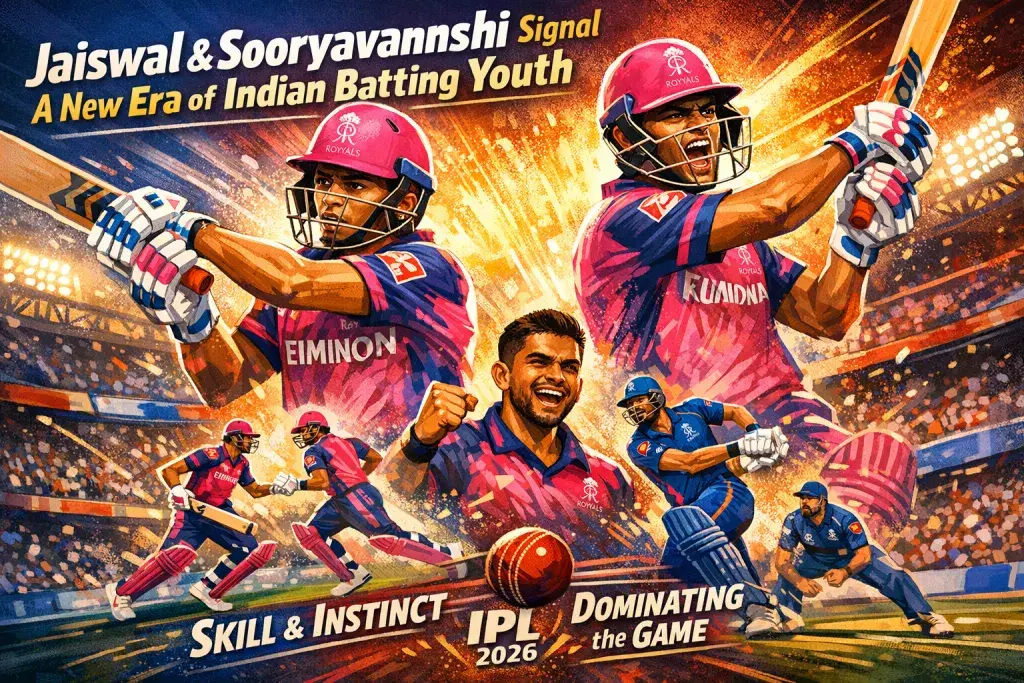
Rajasthan Royals captain Riyan Parag called his side's opening duo of Yashasvi Jaiswal and Vaibhav Sooryavanshi "the best going around" after a commanding 27-run victory over Mumbai Indians on April 8, 2026 — a result that underscored how decisively youth has come to define the highest levels of Indian cricket. The rain-reduced contest, cut to 11 overs per side, gave both openers a concentrated stage: Jaiswal finished unbeaten on 77 from 32 deliveries, while Sooryavanshi contributed 39 off just 14 balls, propelling Rajasthan to 150 for 3 in the first innings.
Controlled Aggression, Not Reckless Power
What distinguishes this particular partnership from the broader wave of power-hitting that has defined the IPL's evolution is the quality Parag himself was careful to identify. "It is not one-way slogging," he said — a pointed distinction. Jaiswal, who has been performing at this level for three to four years now, brings technical discipline earned over a grinding domestic career. Sooryavanshi, considerably younger, adds raw timing and an instinctive reading of length that is rare at any age. Together, they represent something more considered than brute force: a combination of studied skill and natural instinct operating in tandem under high-pressure conditions.
Sooryavanshi's rise has attracted particular attention not simply because of his output but because of how early it has arrived. Young cricketers entering high-octane franchise environments at a formative stage face significant demands — technical, physical, and psychological. The ability to perform with consistency, rather than in isolated bursts, is the measure that separates genuine talent from novelty. Parag's public confidence in Sooryavanshi suggests the Rajasthan management views the youngster as a long-term asset rather than a short-term experiment.
A Bowling Unit Built on Pace and Precision
Rajasthan's victory was not only a story of batting brilliance. Their bowling effort to restrict Mumbai Indians to 123 for 9 was methodical and multi-dimensional. Nandre Burger claimed 2 for 21, Sandeep Sharma took 2 for 25, Ravi Bishnoi contributed 2 for 26, and Jofra Archer — operating across just two overs — returned figures of 1 for 17 while consistently exceeding 145 kilometres per hour. Parag described Archer's role with unmistakable admiration: "Someone who bowls more than 140–145 and has control is crazy." It is a fair characterisation. Sustained pace above that threshold, combined with the discipline to land the ball where intended, is an exceptionally rare combination at any level of the format.
Burger, the South African left-arm quick, has brought a different kind of threat — a back-of-a-length style that exploits variable bounce and creates awkward angles for right-handed batters. The pairing of two fast bowlers with complementary styles, supplemented by Bishnoi's wrist-spin variations, gave Rajasthan control across all phases of the innings. This structural depth in bowling is what separates sides that win comfortably from those that rely on individual moments of brilliance to scrape through.
Youth, Identity, and the Longer Arc
Parag's broader reflection on the victory carried a tone that went beyond post-match satisfaction. "I have always known this to be a strong side because we have a strong and young core," he said, framing the win within a longer narrative of institutional confidence. That framing matters. Rajasthan have historically invested in identifying and developing young Indian talent early — Jaiswal himself being among the clearest examples of that pipeline producing results at the highest level.
The broader implication for Indian cricket is significant. A generation of players now entering the IPL system are products of a domestic structure that, over the past decade, has grown considerably more competitive and demanding. The result is that when these cricketers arrive in franchise environments, they carry not just raw ability but a baseline of experience that accelerates their development. Sooryavanshi's composure — performing on one of the biggest stages available, at an age when most players are still finding their footing in domestic cricket — is an illustration of that structural dividend paying off in real time. Whether this partnership holds its form across a full campaign remains to be seen. But the evidence from April 8 gave Parag every reason for the confidence he expressed.